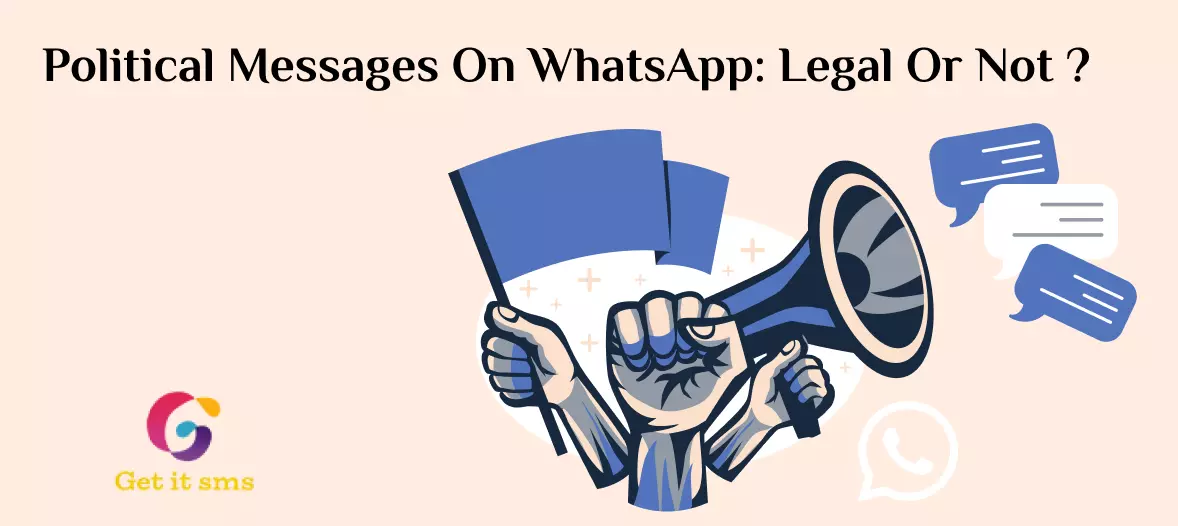
Political Promotion Messages On WhatsApp: Legal Or Not?

No Credit Card Required
Want To Send Bulk SMS?
If yes, then test our service for FREE.
Get a 1 Month Free Trial of WhatsApp Business API
Political messages on WhatsApp are flooding millions of phones each election season. But the question is, is it actually legal?
Being the most popular messaging app and with an active user base of 3.3 billion, it is no surprise that political parties see it as the ultimate voter outreach tool. But before any campaign team hits send, there is one thing each political marketer needs to know.
Meta does not allow political parties, candidates, or campaign organizations to use WhatsApp for sending promotional messages via WhatsApp Business. It is officially banned under Meta’s business Messaging policy.
Yet many political parties and campaign teams still use WhatsApp to reach voters by finding some workarounds. Some rely on third-party bulk messaging services, while others share campaigns via volunteer networks or WhatsApp groups. What’s really going on?
In this guide, we will discover what exactly Meta’s policy says, who is banned, the real risks involved, and what legal alternatives exist for running successful campaigns in 2026.
What Are Political Messages on WhatsApp?
Political messages on WhatsApp are messages shared by political parties, candidates, and supporters to communicate with voters. They are typically used to promote views, encourage people to vote, influence public opinion, and share information about the campaign. Other than the election section, party updates, rally invites, fundraising appeals, and policy announcements are also eligible.
Here’s a common example of political WhatsApp messages:
- Election campaign announcements
- Party manifesto highlights
- Rally and event invitation
- Candidate introductions and achievements
- Polling day updates and voting information
- Voter awareness and registration reminders
On WhatsApp, political messages can take any form, including text, images, videos, and voice notes. Be it a party, a candidate, a campaign agency, or a volunteer, it does not matter at all who sends it. If the intent is political, it does count.
With a billion-user base, WhatsApp dominates the main electoral democracies like India, Brazil, Nigeria, and Mexico. And due to its direct and instant approach, the channel has become the preferred way for political outreach.
Are Political Promotional Messages on WhatsApp Legal in 2026?
No. Sending political promotional messages on WhatsApp violates Meta’s official policy. And this applies globally, not just in selected countries. But the answer has two layers. Knowing both is vital before your campaign team makes any decisions.
The hard ban covers everything on the official Business side. WhatsApp Business App and WhatsApp Business API, and any third-party tool built on top of the API, are completely off-limits for political use.
So if your party or campaign uses any of these tools to send promotional messages, you are simply violating Meta’s terms of service. The consequences are a permanent account ban with no recovery. While personal accounts used manually are not explicitly banned. But this gray area is not consequence-free. Here’s what it still permits:
- A candidate messaging their own contact personally.
- Counter shares content within its own networks.
- Small group chats built from genuinely consenting members.
And this is what crosses the line even on personal:
- Coordinating hundreds of personal accounts to floss WhatsApp groups.
- Any bulk messaging or automated behaviour.
- Fake or inauthentic accounts are spreading political content.
- Anything Meta classifies as “coordinated inauthentic behaviour.”
To sum up, relying on a personal account is like walking on thin ice. Even without a courtroom, your campaigns can be canceled within minutes by WhatsApp’s automated spam filters. It is important to know the exact Meta compliance and actual government laws to keep your account safe.
What Does Meta’s Official Policy Say About Political Campaigns on WhatsApp?
Meta’s position on this has been clear and consistent since 2019 and applies globally. However, the policy was last reviewed and confirmed in March 2026.
Who Is Banned from the WhatsApp Business Platform?
- Political parties and affiliated organizations
- Politicians and election candidates
- Campaign teams, managers, and political consultants
- Voter targeting and election technology companies
- Private firms offering voting solutions or election systems
- Law enforcement, military, and intelligence agencies
These bans cover both the WhatsApp Business App and the WhatsApp Business API in all the countries where WhatsApp operates. Plus, violating it can also affect your linked Facebook and Instagram accounts.
What does WhatsApp allow?
- One-to-one personal messaging between individuals.
- Group chat with a volunteer member joining.
- Organically sharing news or opinions via personal networks.
- WhatsApp Channels for one-way public broadcasts.
What Does WhatsApp Restrict?
- Spam and unsolicited messages without the recipient’s consent.
- Automated and programmatic messaging at scale.
- Misinformation or political propaganda is spreading in bulk.
- Use of the WhatsApp Business platform by political entities.
The line Meta draws is simple. Until it’s personal, consensual, organic communication, everything is fine. But organized, automated, or deceptive political outreach is not.
Can Political WhatsApp Messages Be Tested Before They Are Sent?
Yes. Testing before sending at scale is one of the smartest things a campaign’s team can do. The earlier you decide on the message, the more time you have to refine it. Testing reveals what works for your voters better before you commit to a full rollout.
Here are the four practical ways to test your political messages:
- Polling: Survey a small voter group with two or three message versions. More instant, cheap, and surprisingly accurate.
- Social Media testing: Post variations organically and enable real engagement data to reveal which versions perform better before you’re ready to scale.
- On-ground feedback: Share messages at local events, community gatherings, or rallies. Real-time reactions are much harder to fake.
- A/B testing: Send two versions to small, separate groups, compare response rates, and scale the winner.
One rule applies across all methods. Always test across different demographics, regions, and languages. Remember, knowing this in advance not just saves time but money and reputation as well.
Why is WhatsApp considered a powerful tool to send Political Messages?
Among all social media platforms, WhatsApp is the most convenient, easy, and effective platform to send or receive messages. The members of the election team use WhatsApp to connect with end-voters, mobilize subscribers, raise funds, and increase poll turnout.
WhatsApp is a powerful tool because it allows one to set up political campaigns and send information to the public while keeping them up-to-date. An important element of any political campaign is a social media strategy, but on the other hand, it is also essential to target and interact with voters as much as possible.
Politicians must find new ways to interact with voters and send political messages on WhatsApp with the wave of it. The most powerful and popular messaging tools give you access to reach many people simultaneously.
Political messages on WhatsApp support users in accessing real-time information such as polls, events, and rallies. Whether any problems arise during the election campaign, WhatsApp fixes the problems as well.
How is WhatsApp set up by political campaigns?
Political campaigns employ WhatsApp in a variety of methods (alone or in combination), particularly in the Global South, where it has a high penetration.
- Share the right information about party activities, policies, and events.
- Build a direct link between politicians and voters.
- Mobilize supporters around shared issues and local concerns.
- Coordinating volunteer networks and campaign ground teams.
Information supplied via WhatsApp has a stronger impact than on other platforms. It is because the platform appears more credible, known, and trusted. Unlike Facebook, where you have thousands of connections you barely know, WhatsApp communication feels more personal and secure. This direct nature makes it one of the most effective and widely used by campaigns despite being banned.
But it can be a drawback as well. Because WhatsApp feels more personal, the messages that arrive from unknown numbers feel more intrusive. That’s why many voters quickly label them as spam. Political marketing strategists also advise sending gradually, using existing supporters, and not sending promotional messages to recipients who have not given consent.
How To Create a WhatsApp Group For Political Messaging?
To promote and reach the audience to get votes from them, WhatsApp allows users to send political messaging that might not be legal. Sending political messages on WhatsApp can cause security and offensive content for the end-users.
Although creating a WhatsApp group for political campaigns and adding everyone to
The group could not be a good idea. Hence, let’s just talk about the campaign and the information that becomes available.
WhatsApp is fast, convenient, and easy to use when you are required to work with your team. To hit the political campaign, you can create a WhatsApp group that takes only some time. We discuss the steps to create a WhatsApp group to send political messages. Click on the “new conversation” by going to WhatsApp and adding the people of your interest.
How User’s Data Used In Political Messages Via WhatsApp?
Phone number databases are a valuable resource for activists because WhatsApp
Communication depends on senders having access to recipients’ phone numbers. Different methods have been discovered by campaigners to gain access to phone number databases.
Marketing professionals and communication firms compile databases, expanding them from their consumer databases (derived from non-political marketing campaigns) that they bring with them.
In addition to the data trade of personal databases by people and businesses, there is.
There are many solutions marketed online that can automate the creation and management of WhatsApp groups as well as the sending of messages. These are the ways that give “thousands of messages” and “unlimited senders.”
How To Deliver Political Messages On WhatsApp?
Delivering political messages effectively relies on three things: the right message, the right audience, and the right timing.
After you test your messages, distribute different versions to the different voter groups. While older voters respond better to straightforward messages, the younger voters engage more with interactive content and short videos. Minority communities are generally best reached via trusted local networks like community groups and religious organizations.
It is important to begin the outreach early via campaigns. As the last-minute outreach rallies outmove voters. Always try to build long-term messaging to easily adapt as the campaign evolves.
But for the ground-level teams, managing voter communication across multiple WhatsApp groups or apps becomes chaotic. This is where GetItSMS helps political campaigns deliver bulk messages via a dedicated virtual number that keeps the campaign organized, trackable, and compliant.
Conclusion
Political messages on WhatsApp have always remained one of the most debated topics in modern election campaigns. And for good reason only. Obviously, unmatched reach, unbeatable personalization, and cost-effectiveness naturally attract political campaigns of every size. But the rule by Meta on this is very clear. Using WhatsApp Business App or WhatsApp Business API for political promotion is officially banned under Meta’s policy globally.
Personal account use sits in a grey area, but that does not mean safe. Spam filters, coordinated behaviour detection, and national electoral laws are each applicable to it as well. However, the smartest campaign teams in 2026 are not fighting the ban. They are simply working around it intelligently to reach voters at scale without the risk.
Frequently Asked Questions
No, WhatsApp does not allow interference with users’ privacy and security. Sending political messages on WhatsApp is not legal; it is banned due to its terms.
With GetItSMS, political campaigns can deliver bulk messages via a virtual number to reach their voters during the election time.
No. WhatsApp Broadcast lists are still part of the WhatsApp platform and fall under the same policy restrictions.
The term political messaging defines the form, any act, or non-verbal communication that encourages political tactics, election campaigns, or leaders. When any election is held to reach the audience, political messaging is used for that political reason.
WhatsApp generally does that via how many chats a message is forwarded to at once and automated spam detection systems that flag suspicious messaging behaviour.



 within 24
Hrs +
60
Days Free API Panel
within 24
Hrs +
60
Days Free API Panel